
Interviewsand Articles
A View of Los Angeles: The Paintings of James Doolin
by Richard Whittaker, Nov 2, 2001
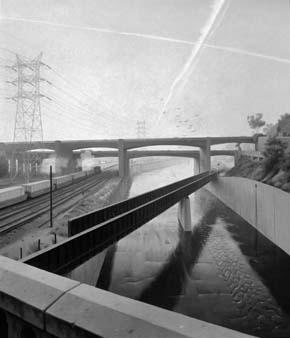


A recent show at the San Jose Museum of Art [July-October 2001] introduced me to the paintings of James Doolin where his work was hung with the work of painter Chester Arnold. The pairing was an inspired one. Both are exceptional painters addressing related issues.
Doolin came to Los Angeles in the mid-sixties from the Eastern U.S. and the shock of the transition left him "stunned, awed, and horrified." What he found was a landscape "at once spectacular and outrageous." 2 .jpg)
I imagine this experience is not uncommon. The landscape of the eastern United States, much of which lies within a mountainous belt running down through New England into the deep south—a landscape green, lush and relatively close, and one with a well-defined cycle of seasons—is utterly unlike the landscape of Southern California and the southwest in general. No doubt, many of the thousands who moved west to Southern California traveled by car or truck, probably along route 66. That's how it worked when, at the age of 12, my family moved to the greater Los Angeles area from the Appalachians of West Virginia.
After days of driving across the U.S. in mid-summer, one enters the promised state at Needles, typically roasting at about 110 degrees. Welcome to California! Pushing on through the Mojave Desert in the shimmering heat, one reaches Barstow where—for the emigrant from the green—dismay can turn into something worse.
By the time one is within striking distance of LA, it gets a bit better, but I often describe my own experience of coming to LA as a 12 -year-old as feeling like I'd arrived in some kind of hell.
Doolin was not a child when he arrived in Los Angeles and his own shock had to be more tempered than mine, though perhaps not fundamentally different. But, as may be true of many transplants to Los Angeles, eventually one gets adjusted.
In 1992 he writes, "After many years of observing and laboring through the process of putting together hundreds of pictures of this extraordinary landscape, I find that I no longer hate it. I find it to be a rich source of exotic, paintable forms, full of ideas about our culture and art." 3
In reading Doolin’s writings about his work on.jpg) e gets the impression that he’s given a lot of thought to artificiality and simulation, perhaps especially to "a kind of artificiality that is not the accidental result of substitution or mechanical fabrication, but based in conscious simulation and deception."4 And it’s hard not to think, what better place than Los Angeles for an on-going study of such things?
e gets the impression that he’s given a lot of thought to artificiality and simulation, perhaps especially to "a kind of artificiality that is not the accidental result of substitution or mechanical fabrication, but based in conscious simulation and deception."4 And it’s hard not to think, what better place than Los Angeles for an on-going study of such things?
By some measures, the hallmark of postmodernism is the outright affirmation of artificiality and simulation. To this, one might contrast an earlier attitude, the affirmation of authenticity, which we could say came along with modernism. Such simplification overlooks a lot for the sake of brevity, but in these terms, it’s clear that Doolin's is a voice of authenticity calling on us to ponder where a culture, pumping out ever greater doses of illusion, leads.
Focusing on just one aspect of this—although a fundamental one—Doolin observes that it’s "one step to import water to create an artificial oasis, and another to pretend that the oasis is natural. The final step is to enlarge the scale so that there is nothing but oasis as far as one can see, cutting off all awareness of another reality."5
Given such concerns, one might wonder why Doolin’s paintings are so beautiful. But does that question mean that one’s focus has become too narrow? Yes, there’s the deep concern about all that's wrong, but even deeper is the mystery of being here at all. There's something awesome in the network of freeways, streets and parking lots that cover thousands of square miles of the earth of Los Angeles.
To see this in a certain light is to behold something else than simply a world out of balance. The strangeness of it exists right along with, at times, an awesome beauty. Perhaps it's precisely in their beauty that some of Doolin's paintings approach the impersonal. Yet these works lose none of their ominous resonance which, in lesser works, might not reach beyond the merely polemic. In this they have the power to touch us in a deeper way. — Richard Whittaker
1. James Doolin, "Art and Artificiality: Southern California" Architecture California V. 14, no. 2, Nov. 1992 p.9
2. ibid., p. 9
3. ibid., p. 12
4. ibid., p. 10
5. ibid., p. 12
About the Author
Richard Whittaker is the founding editor of works & conversations and West Coast editor of Parabola magazine.
SUBSCRIBE NOW
TO OUR MONTHLY NEWSLETTER

A Man Impossible to Classify photo: r. whittaker One of my first experiences in San Francisco ... Read More 749921 views

The Dumpster “We can’t use these. They look like ... Read More 162234 views

Cotton and Silk Vorbeck quilt, detail I’m working on the last panel of a pair of ... Read More 14825 views

Say Grace I am deeply delighted to live on a planet that is so big and varied that I can ... Read More 13555 views

An Interview with Betsy Damon I first heard about Betsy Damon from Sam Bower of greenmuseum.org. Water ... Read More 49107 views
READ MORE >>
A Man Impossible to Classify photo: r. whittaker One of my first experiences in San Francisco ... Read More 749921 views

Interview with Bill Douglass - Jimbo's Bop City and Other Tales At the time I'd first gotten to know the widely respected ... Read More 371796 views

Greeting the Light It was thanks to artist Walter Gabrielson that I was able to get ... Read More 329834 views

Interview: Gail Needleman Gail Needleman taught music at Holy Names University in Oakland, ... Read More 197098 views
The Dumpster “We can’t use these. They look like ... Read More 162234 views
READ MORE >>
FOLLOW US


Share Your Comments and Reflections on this Conversation: